Product photos used to be a once-a-year expense you grit your teeth through. Book the photographer, ship the products, wait weeks for edits, then stretch those same images across your website, your ads, and your emails until next year's budget. That model is breaking, because AI product imagery has gone from a gimmick to genuinely usable, and ecommerce brands that ignore it are paying more for less.
This isn't an argument that photographers are obsolete. They're not, and we'll cover exactly where a real shoot still beats anything a model can generate. But if you're an Australian ecommerce brand deciding where your creative budget goes this year, you need an honest picture of what each option costs, what each does well, and how the two work together.
What Traditional Shoots Really Cost
The invoice from the photographer is only the start. A typical product shoot for a small ecommerce brand runs into the thousands once you add up the day rate, studio hire, props and styling, and retouching. Add models and the cost climbs fast, with talent fees, usage rights, hair and makeup, and a stylist all stacking on top.
Then there's the cost nobody puts on a spreadsheet: time. You're packing and shipping products to the studio, going back and forth on a shot list, waiting on edits, and requesting revisions. From booking to final files, a few weeks is normal. If a product sells out, changes packaging, or gets discontinued in that window, those images are dead on arrival.
The maths gets worse the bigger your catalogue is. A brand with 200 SKUs can't realistically shoot lifestyle imagery for all of them, so most products sit on the site with a single white-background photo while the hero products get all the love. Your ads then recycle the same handful of images until creative fatigue sets in and performance slides.
None of this means traditional shoots are bad value. For the right images they're excellent value. The problem is that the cost structure forces you to be precious with photography, planning everything around one or two shoot days a year, when modern marketing burns through creative every single week. The economics of the shoot and the appetite of the channels no longer match.
What AI Product Imagery Actually Is Now
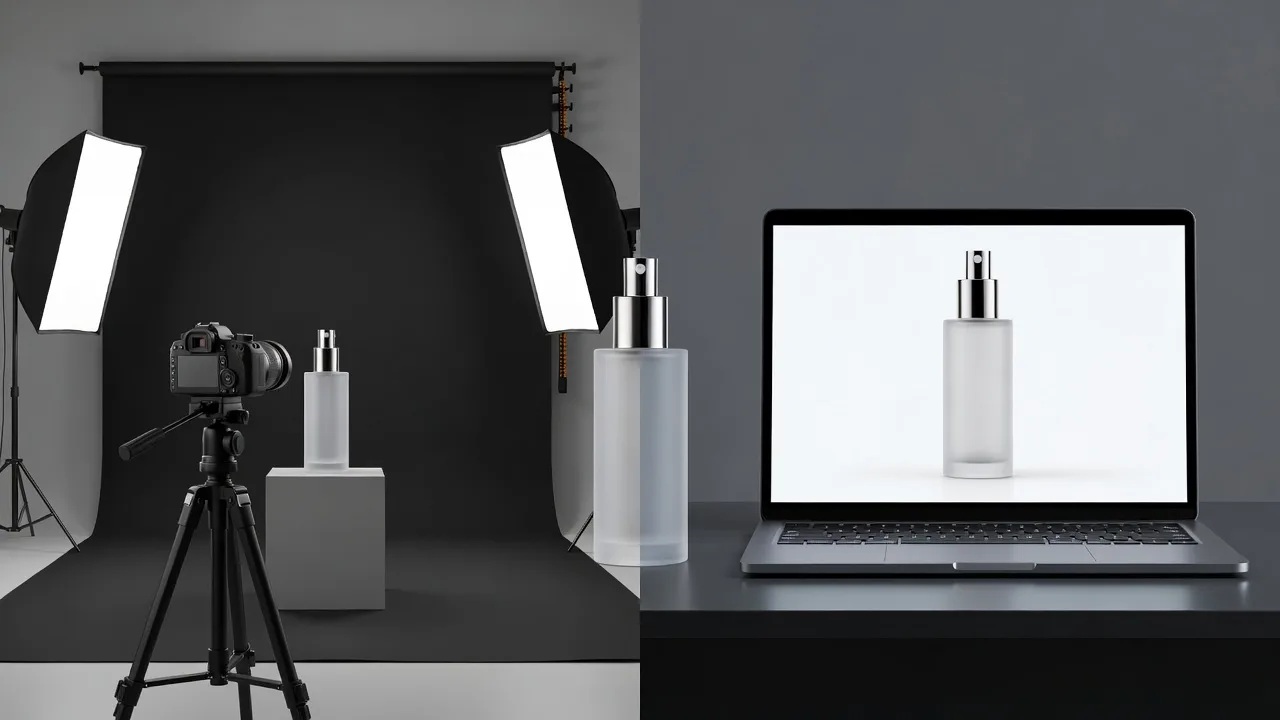
Forget the warped hands and melted logos from a couple of years ago. Modern AI product imagery starts with real photos of your actual product, usually simple phone or white-background shots, and places that product into generated scenes. Your moisturiser on a marble bathroom shelf at golden hour. Your boots on a model walking through long grass. Your candle styled for a Christmas campaign in July.
The product itself stays real. The environment, lighting, styling, and context around it are generated. Done properly, with careful prompting and quality control on every output, the results are strong enough that they sit comfortably alongside shot photography in ad feeds and on product pages. Done lazily, you get plastic-looking images that scream AI, which is why the skill is in the process, not just the tool.
The Real Test Is the Scroll
The question isn't "can people tell it's AI under a microscope." It's "does this image stop a thumb in a feed and represent the product honestly." That's the bar, and good AI imagery clears it.
Where AI Wins: Speed, Variations and Seasonal Content
Speed is the obvious one. What takes a shoot weeks takes AI hours. You can brief a concept in the morning and have usable imagery the same day, which changes how you run promotions. Flash sale this weekend? New imagery by Friday. No studio availability to worry about, no shipping products anywhere.
Variations are where it gets genuinely powerful for advertisers. Instead of one hero image, you can produce the same product in ten different scenes, backgrounds, and moods, then let the ad platform tell you which one converts. Testing creative at that volume with traditional photography would be financially absurd for most small brands.
And seasonal content stops being a planning nightmare. Christmas, EOFY, Mother's Day, Black Friday: you can generate campaign-specific imagery for each without booking a shoot months ahead. For brands with big catalogues, AI also means the long tail of products finally gets lifestyle imagery instead of a lonely white-background shot. We went deeper on this shift in how AI is changing ecommerce.
Where a Real Shoot Still Wins
Some things you can't generate. Real people genuinely using your product, founder and team photos, behind-the-scenes content, your actual store or workshop. That's trust-building material, and audiences increasingly value knowing what's real. A brand built entirely on generated imagery starts to feel hollow, especially for a local business whose whole edge is being real and nearby.
Texture-critical products are another. Fine jewellery, high-end fabrics, food where the exact glisten matters: when the product's surface detail is the selling point, a skilled photographer with proper lighting still produces results AI can't reliably match. The same goes for true-to-life colour accuracy on products where a slight shift means returns.
And there's a legal and ethical line: imagery must represent the product honestly. Australian Consumer Law doesn't care whether a misleading image came from a camera or a model. If a generated scene changes how the product itself looks, don't publish it.
The Hybrid Approach Most Brands Should Run
The smart move isn't choosing a side. It's splitting the job. Use a real shoot, once or twice a year, for the foundation: clean product shots of every SKU, founder and team photos, and a set of genuine lifestyle images with real customers or models. That's your trust layer and your raw material.
Then use AI for volume and velocity: ad variations, seasonal campaigns, email headers, new background scenes for product pages, and imagery for the products that never justified shoot budget. The real photos anchor the brand. The generated imagery keeps the content engine fed every week without another invoice.
Shoot the Foundation
Real products, real people, real premises. One or two shoots a year covers the trust layer.
Generate the Volume
Ad variations, seasonal scenes, and long-tail catalogue imagery, produced in days instead of weeks.
Getting Started Without Risk
You don't need to overhaul your whole catalogue to test this. Pick three to five products, ideally ones you're actively advertising, and have AI imagery produced for them: a few scene variations each, built from your existing product photos. Run them in your ads alongside your current creative and let the results decide. If the generated images match or beat your shot photography on cost per purchase, you've found a cheaper content engine. If they don't, you've spent very little to learn it.
The trap to avoid is doing it half-heartedly with free tools and no quality control, getting one warped image, and writing the whole approach off. The gap between amateur and professional AI imagery is enormous, and it's a process gap, not a tool gap. That's exactly what our AI image service handles, including fashion-specific work where on-model imagery is the hard part.
If your product photos are stale and your ad creative is fatiguing, this is one of the cheapest fixes available to an ecommerce brand right now. Reach out to MakeItScale or book a time to call and we'll show you what your products look like with a proper AI imagery pipeline behind them.