Why Reviews Decide Who Gets the Click
Picture the map pack for "dentist Southport". Three businesses, side by side. One has a 4.9 from hundreds of reviews, one has a 4.1 from a few dozen, one has a 3.8 from nine. You already know who's getting the call.
Reviews do two jobs at once. First, they're a ranking factor. Google's own local search documentation states that review count and score feed into local ranking, so businesses with strong, steady reviews literally show up higher. Second, they're the tiebreaker. BrightLocal's consumer survey work consistently shows that the vast majority of people read reviews before choosing a local business, and most won't seriously consider a business sitting below around four stars.
That means reviews aren't a nice-to-have sitting next to your marketing. They are the marketing. Every dollar you spend on ads or local SEO works harder or fails based on what people see when they land on your profile. Two Gold Coast businesses can offer identical service at identical prices, and the one with the stronger review profile will win the search, the click, and the customer, week after week.
What Actually Stops Customers Leaving Reviews
Here's the thing most business owners get wrong: customers don't skip reviews because they're unhappy. The overwhelming majority of your happy customers leave no review at all, and it's almost never about you.
The real blockers are mundane. They were never asked. They were asked at the wrong moment, days after the job when the goodwill had faded. They couldn't be bothered finding your business on Google, logging in, and typing something. Or they didn't know what to write, so they wrote nothing.
There's a useful pattern hiding in that list: every blocker is friction, and every bit of friction is something you control. The businesses with hundreds of reviews aren't luckier or better loved than you. They've just removed the obstacles between "happy customer" and "published review". That's the whole game, and the rest of this article is how to play it.
The Ask: Timing and Wording That Works
The single biggest improvement you can make is asking, every time, at the right moment. The right moment is the peak of the customer's satisfaction. For a tradie, that's standing in front of the finished job. For a cafe or retail store, it's at the counter when they've just told you they love it. For ecommerce, it's a few days after delivery when the product has landed and impressed.
The wording matters more than people think. Generic asks get generic results. The ask that works is personal, specific, and gives the customer a reason that's about them helping you:
Wording That Actually Gets Reviews
"Really glad you're happy with it. We're a small local business and Google reviews make a huge difference for us. If you've got 30 seconds, would you mind leaving one? It helps if you mention what we did for you."
That last line is doing quiet SEO work. When a customer writes "fixed our blocked drain in Mermaid Waters same day", that review now contains the service and the suburb, which strengthens your relevance for exactly those searches. You can't tell people what to write, but nudging them to describe the job gets you there naturally.
One thing to avoid: never pay for reviews, swap discounts for reviews, or only ask customers you know were thrilled while screening out the rest. Google's policies prohibit incentivised reviews and review gating, and getting caught can mean losing every review you've earned.
Making It Effortless: QR Codes and SMS Links
Once the ask is right, kill the friction. Every step between your ask and the review form costs you completions, so the goal is one tap.
Your Direct Review Link
Google gives every business a short link that opens straight to the review form. Grab it from your Business Profile dashboard. This is the foundation for everything else.
QR Codes In Person
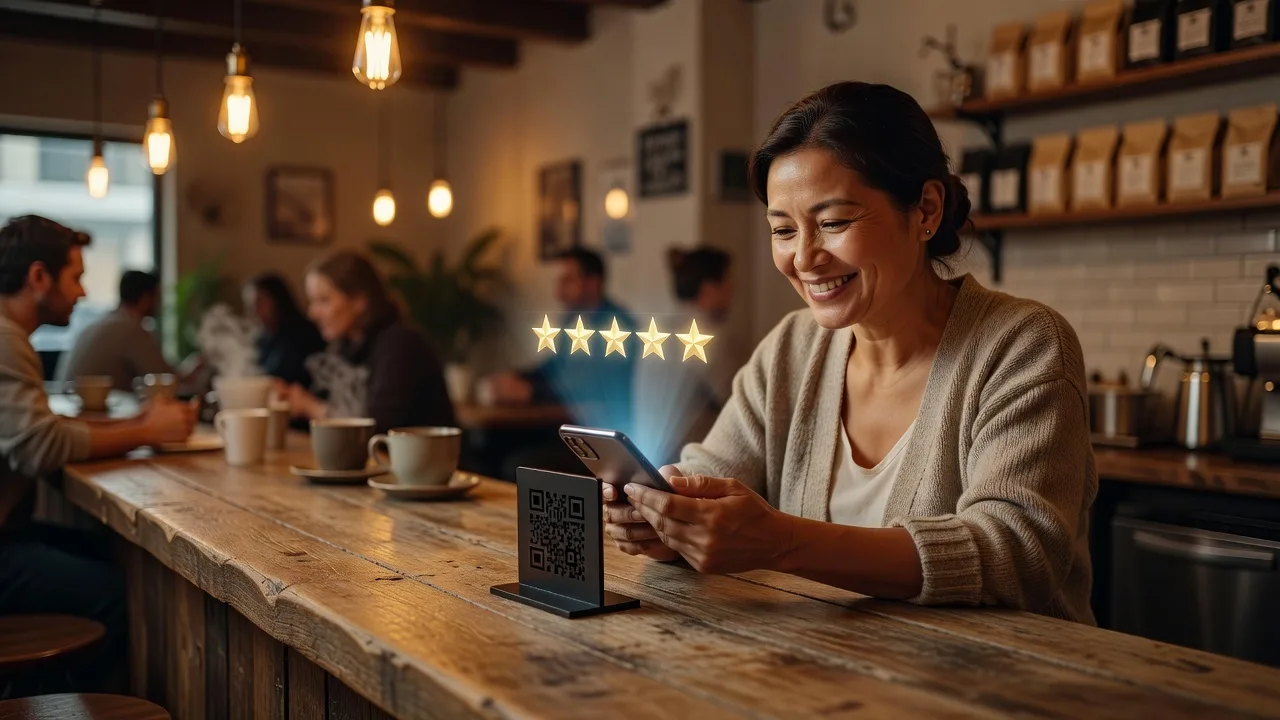
Turn the link into a QR code and put it where the happy moment happens. On the counter, on the invoice, on a card the tradie hands over at the end of the job.
SMS After the Job
A short text within a few hours of the job: thanks, plus the link. Texts get opened almost immediately, which is exactly what you want while the goodwill is fresh.
The best version of this is automated. Job gets marked complete in your system, the thank-you text with the review link goes out on its own, no one has to remember anything. That's a small piece of the kind of growth systems we build for local businesses, and it's usually the one with the fastest payoff.
Responding to Every Review
Every review deserves a response, including the five-star ones that just say "great service". Here's why it's worth the few minutes a week it takes.
Google encourages owners to respond and treats an actively managed profile as a stronger one. Future customers read your responses too, and a profile where the owner replies to everything reads as a business that cares after it's been paid. Silence reads as the opposite.
Keep responses short, personal, and varied. Use the customer's name, mention the job if you can, and don't paste the same sentence under every review. "Thanks Sarah, glad the new hot water system is sorted, enjoy it" takes ten seconds and does more for trust than another ad ever will. Set a rhythm, once or twice a week, respond to everything new, done.
Handling Bad Reviews Properly
You will get a bad review eventually. Every business does, and counterintuitively, a profile with nothing but perfect fives can read as less believable than one with a couple of honest gripes handled well. What matters is what you do in the 24 hours after it lands.
The rules are simple. Respond quickly, stay calm, and write for the hundreds of future customers reading the exchange, not for the one angry reviewer. Acknowledge the experience, state your side briefly and without excuses if the facts matter, and move the conversation offline: "Sorry this happened, it's not our standard. Call me directly on the number on our profile and I'll sort it out."
Never argue, never get personal, and never write a heated reply on the spot. If a review is genuinely fake or breaches Google's policies, report it through your dashboard, but don't count on removal. Your visible, professional response is the real fix. And the best defence against any bad review is volume: one 2-star sting in a sea of recent 5-stars barely moves your average or anyone's opinion.
Keeping It Consistent
A burst of twenty reviews after reading an article like this, followed by silence for eight months, doesn't get you much. Google favours a steady flow of recent reviews, and customers check the dates. A profile whose latest review is from last year quietly suggests a business that's gone stale.
Consistency comes from process, not motivation. Make the ask part of how every job or sale ends, the same way invoicing is. Put the QR code where it can't be forgotten. Automate the SMS follow-up so it happens without anyone thinking about it. Then check your profile weekly to respond to whatever came in.
Do that for six months and you'll have a review profile most of your competitors can't catch, because they'd need to start where you started and most never will. Reviews compound. Every one you earn keeps working for you in every search, every day, for free.
If you want this set up properly, the link, the QR codes, the automated follow-ups, and the rest of your local search presence sorted alongside it, that's exactly the work we do for Gold Coast businesses. Get in touch or book a time to call and we'll map out your review system together.