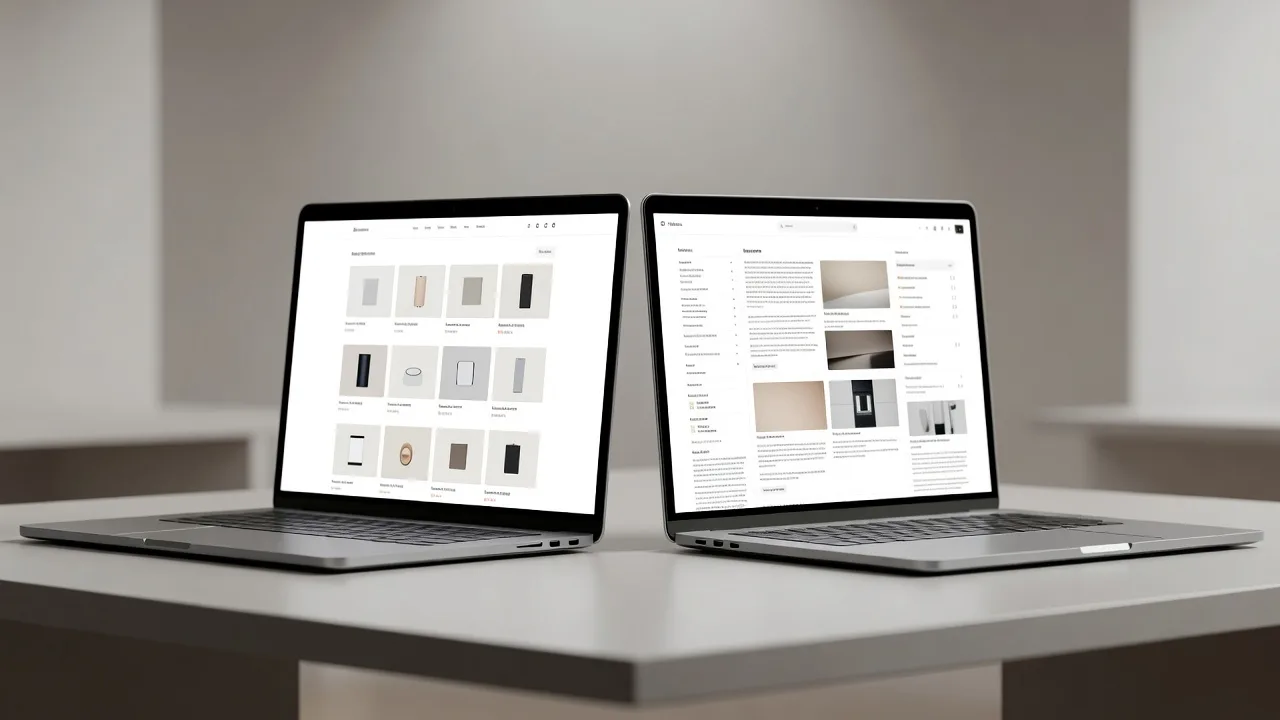
The Real Question: Selling Products vs Everything Else
Most Shopify vs WordPress articles compare feature lists. That's the wrong frame. The decision actually comes down to one question: is selling physical products online the core of your business, or is your website mainly there to win enquiries, bookings and trust?
Shopify is an ecommerce platform that happens to have pages. WordPress is a content platform that can be taught to sell through WooCommerce. They overlap in the middle, and that overlap is where most Australian small businesses get stuck choosing.
Get the frame right and the choice usually makes itself. A boutique shipping orders every day has fundamentally different needs to a Gold Coast plumber whose website exists to make the phone ring. The rest of this article works through where each platform genuinely wins, what they really cost over the years you'll own the site, and what we'd recommend depending on what your business actually does.
Where Shopify Wins
If your business lives or dies on online orders, Shopify is hard to argue against. Everything a store needs is native: products, variants, inventory, checkout, payments, shipping, taxes, abandoned cart recovery. You don't assemble it from plugins, it's just there, maintained by Shopify, working the same way tomorrow as it does today.
The checkout is the headline. Shopify's checkout is one of the most heavily optimised purchase flows on the internet, with Shop Pay and every payment method Australian shoppers expect. You will not build a better one yourself, and checkout is exactly where you can't afford weak links. We've seen the difference a trustworthy, fast checkout makes often enough that it's a core part of how we approach Shopify conversion rates.
Hosting, security and speed are also Shopify's problem, not yours. The platform handles traffic spikes from a sale or a viral post without you thinking about servers. And when you start running ecommerce ads, the integrations with Meta and Google are first-class, which matters more than people realise: clean product feeds and reliable conversion tracking directly affect what your ads cost.
The trade-off is control. You customise within Shopify's rails. For most product businesses that's a feature, not a limitation, because the rails are good.
Where WordPress and WooCommerce Win
WordPress powers a huge share of the web for a reason: it can become almost anything. If your website is primarily about content, services, bookings or anything that isn't a standard product catalogue, WordPress gives you freedom Shopify can't match.
Content and SEO depth. WordPress was built for publishing. If your growth strategy leans on blogging, location pages, resource hubs and long-term organic search, it's a comfortable home for that work, with full control over site structure and URLs.
Total flexibility. Custom quote calculators, member areas, directories, complex booking flows, unusual product logic. If you can spec it, someone can build it on WordPress. WooCommerce extends that flexibility to selling, which suits stores with genuinely non-standard requirements.
Ownership. Your site is yours. You choose the host, you can move it anywhere, and you're not renting your store from a platform that sets the rules. No checkout transaction conditions, no platform fees on top of payment processing if you set things up well.
The trade-off mirrors Shopify's: with freedom comes responsibility. Every capability you bolt on is a component you now own, update and secure. WordPress wins on what's possible. It rarely wins on what's effortless.
Costs Over Time
This is where the comparison gets misread most. People compare Shopify's visible subscription against WordPress's "free" software and conclude WordPress is cheaper. Over the life of a site, it's rarely that simple.
Shopify's costs are predictable: a monthly subscription, payment processing, and whatever paid apps you add. You can read your next year of platform costs off a single bill. The risk is app creep, where a store quietly accumulates subscriptions it no longer needs, so the discipline is auditing your apps a couple of times a year.
WordPress costs are spread out and easier to underestimate: hosting, premium theme and plugin licences, and, the big one, people. When a plugin update breaks the site or the checkout misbehaves, someone has to fix it, and that someone usually bills by the hour. A WordPress site that's cheap to launch can become the more expensive option once you price in the maintenance it actually needs.
The Fair Comparison
Compare total cost of ownership over a few years, including maintenance hours and your own time, not the sticker price at launch. On that maths, Shopify usually works out better value for product stores, and a well-managed WordPress site better value for content-driven and service sites. Both lose badly to the real enemy: a cheap site on either platform that never converts anyone.
Maintenance and Security Reality
Here's the conversation most web designers skip at handover.
Shopify is closed and managed. Security patches, server updates and platform maintenance happen behind the scenes without you knowing or caring. Your responsibilities shrink to your content, your apps and your staff's passwords. For a business owner with no technical support on call, that peace of mind is worth real money.
WordPress is open and self-managed. The core software, your theme and every plugin all release updates continuously, and unattended sites drift out of date. Because WordPress runs so much of the web, it's also the most attacked platform on it, and outdated plugins are the classic way in. None of this makes WordPress unsafe. A properly maintained WordPress site with good hosting, few well-chosen plugins and regular backups is solid. The key word is maintained: it needs an owner, either you, your developer, or a care plan.
The honest question to ask yourself: who is going to look after this site every month for the next five years? If the answer is "nobody, really", that's a strong argument for Shopify, or for a website partner who handles it for you, which is exactly how we run business websites for our clients.
What We Recommend by Business Type
Product Businesses Selling Online
Shopify, almost every time. Boutiques, supplement brands, homewares, anyone whose revenue is online orders. The checkout, the reliability and the ad-platform integrations outweigh the subscription cost for nearly every store we've worked with.
Local Service Businesses
Either platform can work, because the job is enquiries, not orders. What matters far more is speed, clear offers and a site built to convert visitors into calls, especially if you'll be driving traffic to it with lead gen ads. Choose based on who will maintain it.
Content and SEO-Led Businesses
WordPress. If publishing is your growth engine, you want its editorial flexibility and structural control. Pair it with quality hosting and a maintenance plan from day one.
Hybrids
A service business that also sells a handful of products usually doesn't need WooCommerce's complexity. Shopify with strong pages, or a simple site with payment links, often does the job with far less to maintain.
Making the Call
Strip it back and the decision is short. Selling products as your core business: Shopify. Content, complexity or full ownership as the priority: WordPress, with a real maintenance plan. Local service business that needs the phone to ring: either, because the platform matters less than the build quality and what happens to visitors once they land.
One last warning from experience: the platform is never what makes a website succeed. We've seen conversion machines and disasters on both. The offer, the copy, the speed, the trust signals and the follow-up decide whether your site earns money, and those travel across platforms. The same logic applies to where you send paid traffic, which is why we've written separately about landing pages vs homepages.
If you're weighing this decision for your own business, don't guess. We build and manage sites on both platforms for Gold Coast businesses, and we'll tell you straight which one fits your situation, including when the cheaper option is genuinely the right one. Get in touch or book a time to call and we'll work out the right foundation before you spend a dollar building on the wrong one.